“I was with book, as a woman is with child.”
- C.S. Lewis, Till We Have Faces
This is a pretty accurate analogy of writing. First you conceive the idea. Then it grows and grows inside of you until the bulge of it is hanging there right in front of you whatever you do. You experience strange cravings and sensations. It keeps you up at night. Then the birth pangs come, and there's nothing you can do--you just have to sit and write and write and write and write, all the while wondering if you're going to survive this--until finally, the whole thing is out of you. And when everything is through and you cradle your creation--your own flesh and blood and tears and sweat--in your arms, you forget the past hours and days and weeks and months of pain, and all you know is joy...
Okay, so it's not quite as great as that, because the next morning when you read over what you've written you often realize it's a whole lot more terrible than you remembered. I hope a mother doesn't do that.
Anyway, you witnessed the childbirth process a month ago in my post Stages of an Essay (don't worry--it's nothing graphic) and now I'm following up with the result.
I'm applying for a camp this summer held by a vet school for incoming juniors and seniors interested in the veterinary field. As part of the application students had to write an essay five hundred words or less about what area(s) of veterinary medicine they were interested in and why.
So here is my child. 499 words. And my firstborn essay*.
 |
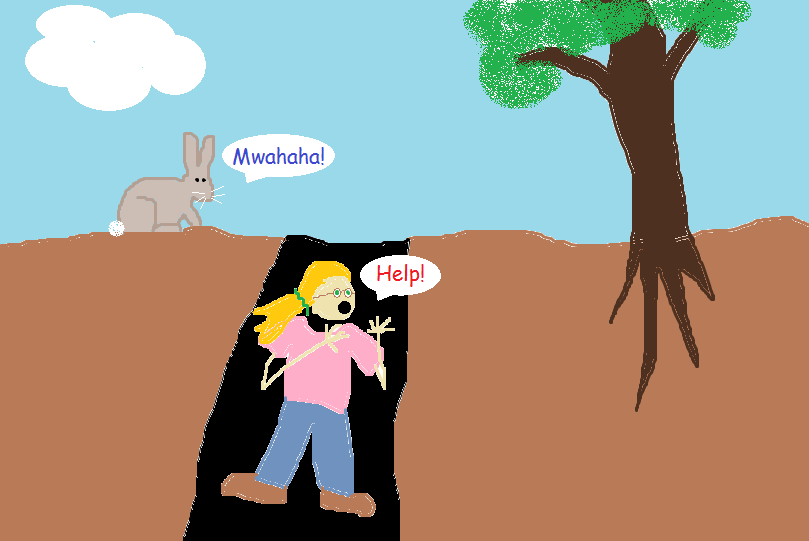
| Unfortunately, they aren't interested in artwork, so my little masterpiece was not included. |
***
When we were young children, my friends and I had a vast array of plastic and plush horses. We formed racing stables and cattle ranches and wild horse herds, and whenever a horse fell ill or hurt itself, I was the one to prescribe various cough syrups and poultices, or experiment with some innovative procedure made up on the spot. Over time I acquired a small library of books like The Complete Equine Veterinary Manual, The Horseman’s Veterinary Encyclopedia, and The Comprehensive Guide to Equine Veterinary Medicine. I lugged these volumes to our play dates and referenced them to give more accurate treatments to my plastic patients.
I was unperturbed by the graphic images in those manuals of festering wounds and animals mid-operation with their bowels splayed across the table. Each morning I poured my cereal in a rush to make it to the TV in time for that day’s episode of Emergency Vets, and happily munched Cheerios while watching a cesarean section performed on a Labrador Retriever. I failed to understand why my mother was so disturbed by this.
When I was eight or nine, I was given a little money to spend at a used book sale held by our homeschool group. As I browsed one of the tables, my eyes fell upon the heftiest volume: a tenth grade biology textbook. It was love at first sight. The best part? It was just fifty cents, perfectly within my limited budget. Passersby grinned as I proudly staggered off under its weight.
Over the years, little has changed. My vision of an ideal Friday night still involves curling up on the sofa with a science textbook. To my parents’ dismay—and that of their wallet—my love of horses didn’t wane either. At the age of eleven, after years of riding lessons and horse camp, I adopted the pony I had gentled at a local horse rescue. She was a spooky mare that had run feral on a mountainside for nearly a decade. Over time I had earned her trust, and I taught her a number of tricks, including giving kisses, swishing her tail on command, answering “yes” and “no” to questions, and dancing the hokey pokey. The two horses I’ve acquired since then have learned a few things watching her, but so far they haven’t quite figured out the hokey pokey.
The veterinarians around me have been very supportive, perhaps empathetic to what others see as a slightly disturbing fascination with animal innards. I was invited to sit by and watch a foal at a nearby riding stable undergo surgery to repair an umbilical hernia, following step-by-step in a surgery manual. When it was time for my own colt to be gelded, our veterinarian handed me the emasculator and allowed me to perform one half of the operation myself. My horse still hasn’t forgiven me for it.
I would be happy in any field of veterinary medicine, but I feel equine practice is what I’m meant to do.
***
Yep. I'm a homeschooler.
*That's right, I never had to write a formal essay before this. Aren't I lucky? I did write other scholarly stuff, but I wrote those of my own accord, which made them nerdy.